Safely Replacing a Two-Story Chandelier
Thinking about replacing a two-story or high-ceiling chandelier? Learn how access, labor, safety, and fixture choice affect the process and the final cost.
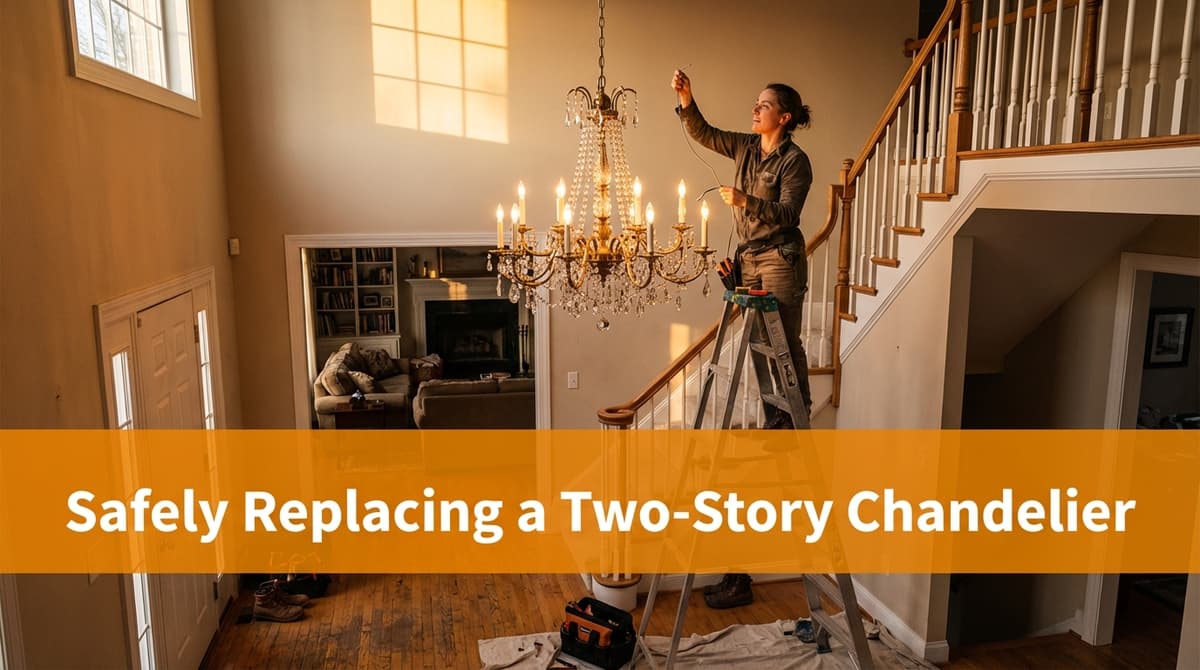
Swapping a Two-Story Chandelier: What Really Goes Into It
We recently got a call from a homeowner — let’s call her Emily — who had a big question for us: could we safely remove a heavy, old-fashioned chandelier hanging over her two-story foyer and replace it with a lighter, modern fixture?
The catch? The chandelier was way up in a vaulted space above the second-floor landing, only accessible from the ground floor. Emily wasn’t sure how high the ceiling was, just that it was “very high” and that the other companies she called either wouldn’t touch it or quoted her eye-popping prices.
Conversations like this come up a lot, so we thought we’d walk through what homeowners should know before replacing a two-story or high-ceiling chandelier — how we access it, what affects labor and cost, and how to make sure the job is done safely.
First Question We Ask: How High and How Heavy?
One of our first questions to Emily was, “What’s the ceiling height?” Even if homeowners don’t know the exact number, we listen to how they describe the space: two-story entry, vaulted ceiling, above a staircase, etc.
That height — along with the size and weight of the fixture — drives almost everything about the job:
- Access equipment: Do we need an extra-tall A-frame ladder, a multi-position ladder, or a scaffold? In some homes, we can’t safely set up a standard ladder because of stairs or railings.
- Labor: Can one electrician handle it, or do we need two people to safely support and lower the existing chandelier?
- Time on site: The higher and heavier it is, the more time we spend just setting up and breaking down safely.
Emily told us her existing chandelier looked a bit antique and probably heavy, but the new one she bought was much lighter and more modern. That combination — heavy coming down, light going up — is something we see often and plan for carefully.
Can One Person Really Do a Two-Story Chandelier?
Emily asked us if this was something we could do with just one person. The honest answer is: it depends on the fixture and the space.
Here’s how we decide whether it’s a one- or two-person job:
- Weight of the old fixture: A very heavy or awkwardly shaped chandelier usually calls for two people, especially when it’s being lowered 15–20 feet.
- Height and layout: Over a flat foyer floor is one thing; over a staircase or balcony is another. Tough layouts sometimes require a helper just to manage tools and safety spotting.
- Assembly complexity: Some modern chandeliers ship in many pieces and must be assembled on site. That adds time and sometimes an extra set of hands.
We told Emily that we can usually handle a lot of these projects with one electrician, but we always reserve the option to bring a second person if the on-site conditions or fixture weight make that the safer choice.
What Impacts the Cost of a High-Ceiling Chandelier Swap?
Emily had already called around and gotten a wide range of quotes — from a few hundred dollars up to several thousand. She wanted to understand why there was such a difference and what a realistic “ballpark” should be.
When we price a two-story chandelier replacement, we typically look at:
- Minimum service/labor: For us, a high-ceiling chandelier job in a standard foyer often starts in the $425–$450 range. That covers travel, setup, safe removal, and installation of a basic fixture.
- Condition of the electrical box: If the existing ceiling box is old, loose, or not rated to support the chandelier’s weight, we have to replace it with a properly rated box. That adds parts and labor.
- Fixture complexity: Crystal arms, individual glass shades, intricate assembly, or integrated LED drivers can all add time and cost.
- Extra equipment: If we need special scaffolding or additional safety gear because of height or layout, that’s factored into the price.
We also explained to Emily that if another company had quoted a much lower price but with a long wait time, it might simply reflect their schedule and business model — but for a job like this, cutting corners on safety, equipment, or time is never worth the savings.
How We Safely Access and Replace a Two-Story Fixture
From the homeowner’s point of view, it can be nerve-wracking to see someone climb that high with a heavy chandelier. Here’s how we keep the process as safe and controlled as possible:
- Site evaluation: We look at the floor, stairs, railings, and any obstacles to choose the right ladder or platform configuration.
- Power off and verify: We shut off the circuit at the panel and confirm the power is truly off before touching any wiring.
- Careful disassembly: For heavier or fragile fixtures, we remove glass, shades, or arms while it’s still hanging to reduce weight.
- Controlled lowering: We support the fixture from below as we disconnect it, then carefully lower it without swinging or banging into walls or railings.
- New fixture prep: Whenever possible, we assemble as much of the new chandelier on the ground as we safely can before lifting it into place.
Our goal is to make it look easy, but behind that is a lot of planning, experience, and respect for how dangerous a fall or dropped fixture could be.
How We Protect Your Floors, Walls, and Home
Emily was also understandably worried about her hardwood floors and painted walls in the foyer. A falling ladder or fixture could do serious damage if a crew isn’t careful.
On high-ceiling chandelier jobs, we build in time to protect the home before we ever touch the light:
- Floor protection: We lay moving blankets or drop cloths where the ladder or scaffold will sit and under the work area in case any small parts are dropped.
- Wall and railing awareness: We position ladders to avoid scraping against railings and banisters and move furniture or decor out of the way if needed.
- Clean-up: After the new chandelier is installed and tested, we remove packaging, old fixtures (unless you want to keep them), and vacuum up any dust or debris in the work area.
Those steps don’t always show up line-by-line on a quote, but they’re part of why a professional chandelier replacement feels smooth and stress-free.
Choosing the Right Replacement Chandelier for a Tall Space
Emily had already bought her new fixture, but many homeowners call us before they order one and ask what will work best in a two-story foyer or great room. Here are a few things we suggest considering:
- Proportion to the space: In a tall foyer, a tiny fixture can look lost, while an oversized one can feel overwhelming. As a very rough guide, adding the room’s length and width in feet and converting that to inches gives a good ballpark diameter for the chandelier.
- Adjustable hanging height: A fixture with adjustable chain or downrods makes it easier to get the chandelier at the right height relative to the floor and any second-floor railing.
- Weight and support: If you’re drawn to a very heavy fixture, we recommend confirming that your ceiling box and structure can support it, or budgeting for an upgrade.
- Ease of maintenance: Lots of tiny glass pieces or complex shapes may look beautiful, but think about how you’ll dust or clean it in the future.
If you’re unsure, we’re always happy to look at photos of your space and the fixture you’re considering and give our input before you buy.
When to Call a Pro (And What to Ask)
High-ceiling chandelier work is one of those projects that looks simple on paper but carries a lot of hidden risk once you’re 15–20 feet up in the air. Between ladder safety, electrical work, and the potential weight of the fixture, we strongly recommend leaving these to licensed professionals.
When you call around for quotes, here are a few good questions to ask:
- Have you done two-story or vaulted-ceiling chandelier replacements before?
- Will you provide all ladders or scaffolding needed for safe access?
- What happens if you discover the electrical box isn’t rated for the new fixture?
- Is the quote a flat price or an estimate that could change based on time and complexity?
For Emily, understanding how access, labor, and the fixture itself affected the cost made the decision much easier. Our aim on every call like hers is to be transparent about what’s involved so you can feel confident that your chandelier will not only look great, but be safely and properly installed for years to come.